Four Ways of Sinking
Four of us watched the sinking sequence from Titanic. Then each of us went off alone for about twenty-five minutes to compress the whole scene into a single movement and a name for it. Back in the group, each person taught their movement while the others took notes. This index follows one set of those notes, four quadrants of pen symbols, through one more translation: a 29-second animation of rounded shapes with orchestral sound.
The chain of translation
Each step hands the next one less of the scene. The last step is the first to add material the scene never had.
- 01
Scenethe film clip
Water, noise, cold, dark, hundreds of bodies at once. Nothing has been reduced yet.
- 02
Movementone body, about 25 minutes to make
The crowd collapses into one person. Each of us chose which part of the scene to carry in the body.
- 03
Namea few words
The movement is given a textual phrase and taught, by demonstration, by instruction, or both.
- 04
Notesone page, four quadrants
Bodies and words drop out. What survives is direction, curvature and repetition: arcs, arrows, hooks, a single dot.
- 05
Rendering29 seconds, 4 colors, 10 instruments
The strokes get time, color and sound back. None of these were in the notes, so most of what you hear and see here is new.
Index of movements
In the order they were taught, which is also the order of the film. Each entry pairs what was on the page with what it became.
-
0:00–0:07 I
Flip
- On the page
- A bowl above an arch, two curves facing each other. Below them, five arrows pointing down.
- Motion
- The two curves flip in opposite directions every 1.7 s, with a small overshoot. The arrows brighten and fade on their own, in five blues.
- Sound
- A low cello drone in D minor. A string chord swells on each flip; a harp note sounds whenever an arrow brightens.
- Tempo
- Slow, like breathing at the surface.
- What changed
- The curves read as the waterline and the hull turning over, one image inverting the other. The arrows were still ink; making them flicker added a question the notes didn't ask: which of these is still visible, and which has already gone under.
-
0:07–0:14 II
Climb
- On the page
- A long rising arc. Top right, fingers hooked over an edge. Top left, three small hooks.
- Motion
- Two hands take turns reaching up, gripping and pulling down, one cycle every 0.4 s. The three hooks rock on the same beat.
- Sound
- Xylophone, one rising note per grip. Snare on the sway, accented and ghosted strokes alternating.
- Tempo
- The fastest section, close to frantic.
- What changed
- A rising scale on xylophone makes the climb sound almost cheerful. That gap between the brightness of the sound and the desperation of the gesture is one of the distances the exercise asked us to feel, and it stays in the piece.
-
0:14–0:22 III
Spin
- On the page
- A diagonal line, a circular arrow wrapped around it, one dot.
- Motion
- A rounded rectangle lands upright and bounces, topples onto the diagonal, then lifts off and spins faster and faster, leaving afterimages and flinging dots.
- Sound
- Timpani on each landing, a cymbal as it falls, a piccolo that climbs in pitch with the spin, a triangle for each thrown dot.
- Tempo
- Still, then a fall, then acceleration with no ceiling.
- What changed
- The tilt of the ship and the people thrown from its deck. One dot in the notes became dozens on screen. This is the only place the rendering gives back some of the crowd that every earlier step removed.
-
0:22–0:29 IV
Shrug
- On the page
- Two arch shapes with short marks above them. Below, one arrow pointing right and one pointing left.
- Motion
- The arch shrugs at irregular intervals, the marks flaring above it, while it slides to random positions left and right.
- Sound
- A two-note bassoon figure for each shrug. A clarinet glide for each move, rising toward the right, falling toward the left.
- Tempo
- Uneven. Never settles into a beat.
- What changed
- The notes show an orderly back and forth. The randomness was added in rendering, as a reading of not knowing where to go. The bassoon's comic timbre sits directly against the scene, and that friction is part of what this entry carries.
The notes
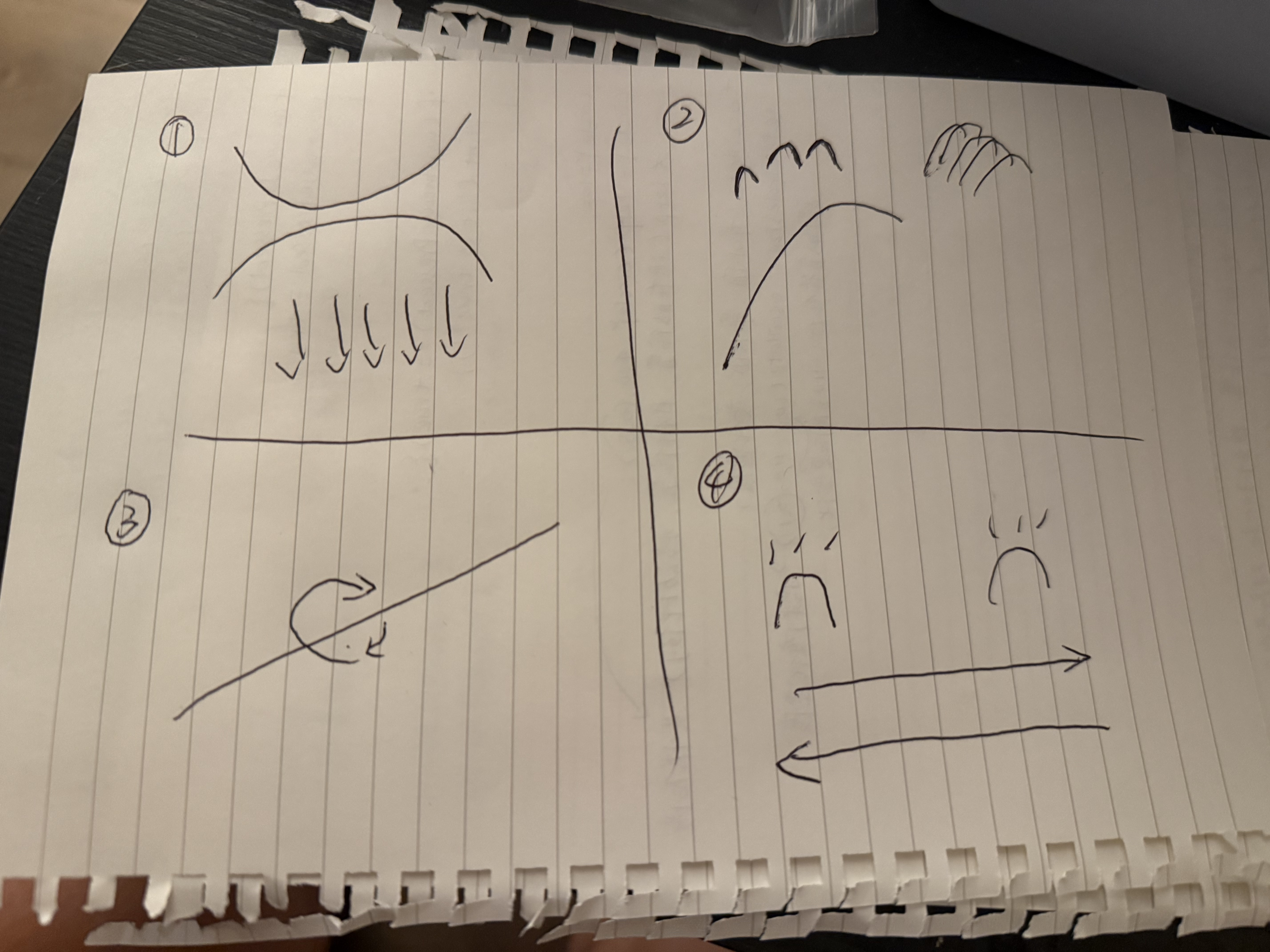
Compression, loss and the rest
Compressed
A long scene with hundreds of people became four bodies, then four quadrants of ink, then 29 seconds. In every entry, one shape stands for many.
Left behind
Faces, voices, cold, the specific people. The names of the movements didn't make it into the notes at all, and the teachers' spoken instructions survive only as the shape of a stroke.
Twisted
Tone. Xylophone and bassoon are bright or comic instruments set against a tragedy. Each entry also got a fixed tempo, which a crowd in the water never had.
Expanded
Color, sound, duration and chance. Four background colors and ten instruments were invented here. The scattering dots and the random shrugs came from the rendering, not the page.